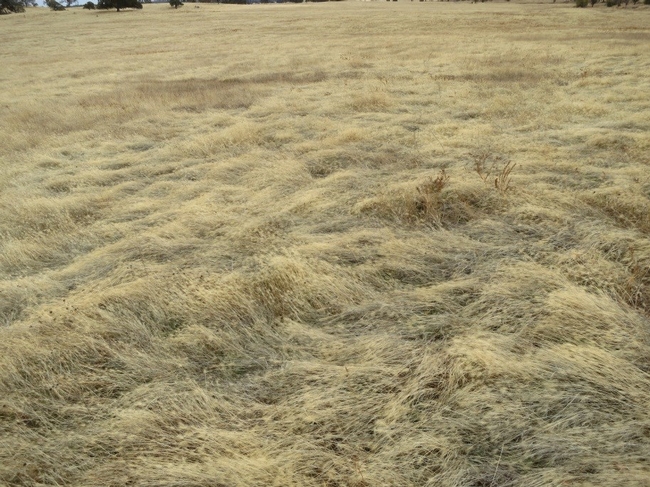
 Abstract: Grazing represents a sustainable alternative for the control of medusahead infestations but intake of medusahead by ruminants is typically low. We determined in sheep whether 1) high-energy supplements enhance medusahead intake and preference relative to a treatment without supplementation and 2) individual differences in medusahead intake transfer to individual differences in the ingestion of a silica-containing ration. Groups of lambs (n=10) were individually penned and randomly assigned to 3 supplementation treatments: 1) Control; no supplement; 2) beet pulp:barley:calcium (Ca) propionate; 67:30:3 , or 3) beet pulp:barley:yeast culture; 65:30:5. After supplementation, all animals had ad libitum access to medusahead in late vegetative to mid-reproductive (Trial 1), and late-reproductive phenological stages (Trial 2). Medusahead preferences were assessed by offering sheep a choice between medusahead and tall fescue hay. Plant part preferences were assessed by offering a choice between medusahead tops (mostly seedheads and awns) and mid-plant parts (mostly stems+leaves). Intake of medusahead was low and cyclic, declining towards the end of each trial (P < 0.